

A PLACE NAMED IN THE RECORDS OF ENGLAND SINCE 1086
The village of Little Chishill sits on the chalk uplands where Cambridgeshire, Hertfordshire and Essex meet, along the line of the ancient Icknield Way. St Nicholas has stood on this hill since the twelfth century. Below is a short history of our church, told in six moments across a thousand years.
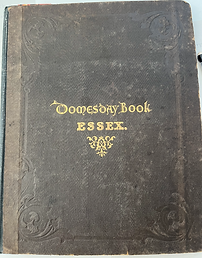
1086
Named in Domesday.
Little Chishill appears in the survey of England ordered by William the Conqueror, twenty years after the Norman Conquest.
In 1086 our village was recorded in the Domesday Book as Little Cishella. It had been held before the Norman Conquest by a free man named Sired, and it was granted after 1066 to Count Eustace of Boulogne, one of William’s most powerful supporters. Although Little Chishill now sits in Cambridgeshire, Domesday recorded it in the Hundred of Uttlesford, in Essex, where the parish remained until the boundary was redrawn in 1895.
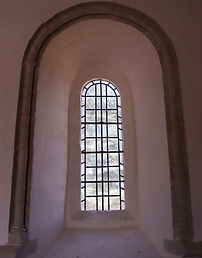
12th century
The Norman chancel.
The oldest part of our building, still standing today, was raised in the twelfth century.
The chancel of St Nicholas is the earliest surviving part of the church. It dates from the twelfth century, and a small Norman window remains in its north wall. That window is the most direct visible link we have with our earliest fabric: the same stone, the same masonry, the same shaped light that people saw here nearly nine hundred years ago.

Late 14th century
The tower and south porch.
Our distinctive squat tower and handsome porch were added in the late fourteenth century.
In the late fourteenth century, the west tower was raised and the south porch added, both in the Perpendicular Gothic style then fashionable across England. Nikolaus Pevsner, in his authoritative Buildings of England, admired our church’s handsome tall porch, with its slender blank arcading inside. The tower’s tiled pyramid cap is unusual for this part of England and gives our building its distinctive silhouette against the sky.
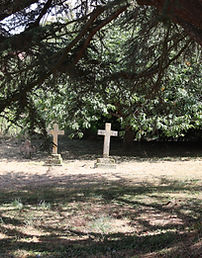
1348 to 1349
The Black Death churchyard.
In the plague years, our churchyard is said to have served as a mass burial ground for surrounding parishes.
Local tradition holds that during the Black Death of 1348 and 1349 the churchyard at Little Chishill was used as a mass grave for plague victims from the surrounding parishes. No record survives to tell us how many were buried here, or where. It is a sombre reminder that this quiet place has stood witness to some of the harder chapters of English history, as well as the ordinary ones.

1880s
Reopened by the Crossmans.
After a period of Victorian closure, the church was reopened and refurnished by the Crossman family of Cokenach.
For part of the nineteenth century the church was closed for services. It was reopened and refurnished in the 1880s by the Crossman family, who had bought the neighbouring Cokenach Estate. Around 1916, the east window was fitted with new stained glass by the celebrated Kempe and Taylor studio, whose work adorns cathedrals and parish churches across England.
Image: Cambridge Daily News

2026
St Nicholas today.
A Grade II* listed building, and one of seven parish churches in the Icknield Way Villages benefice.
St Nicholas is now designated a Grade II* listed building by Historic England, which places it among the top eight per cent of listed buildings in the country. It is one of seven parish churches in the Icknield Way Villages benefice, and remains at the heart of Little Chishill: for worship on the first Sunday of each month, for weddings and funerals and the porch is a popular spot for walkers to stop and rest in.
THE NAUGHTY NUN'S TOMB
On the south side of the nave there is a tomb built half inside and half outside the church wall. The story goes that in it are the relics of a naughty nun, buried in this unusual way because she was thought neither fit for Christian burial within the church nor to be shut out of it altogether.
Local tradition links her to Mincingbury, an old house at Shaftenhoe End just up the road. The name itself is a clue, for it comes from the medieval word for a nun, and the Benedictine nuns of Chatteris Abbey really did own land here in the Middle Ages. The nuns lived at Chatteris rather than at Little Chishill, so the naughty nun is a legend, but one grown around a real medieval fact.
No one knows for certain who lies there, and no documentary record names her. The tomb itself is quite real, though, and it is very unusual. Come and see it for yourself.

FURTHER READING
